
Reusable publishing infrastructure
Shared systems for research, data collection, enrichment, quality checks, publishing, monitoring and distribution across multiple independent digital products.
Urban Sky Web grew from a practical problem: there were more useful ideas to build and publish than there were hours available to do the work manually.
Our mission is to combine artificial intelligence, automation, structured data and web technologies to create online platforms that can research, evaluate, produce, maintain and distribute useful content at extremely low operating cost.
Shared systems for research, data collection, enrichment, quality checks, publishing, monitoring and distribution across multiple independent digital products.
We deliberately explore open-source software, free or low-cost infrastructure, efficient APIs and local compute before adding paid services where they create clear value.
The objective is not simply to generate more content. It is to build systems that can decide what is useful, find the evidence, create the output and keep it current.
Around three to four years before Urban Sky Web was incorporated, the original idea was a social-media project called What10Things: content built around ten useful, surprising or interesting facts about subjects people wanted to understand.
The challenge was time. Producing the research, designing the posts and publishing consistently was difficult alongside full-time work, so the next step was to build a supporting website and learn how the technology worked.
That led to learning HTML, CSS and Python, and eventually to building Flask applications with Jinja templates. The websites became possible, but the manual production process was still too slow to scale.
ChatGPT was initially used to speed up coding and design work. Over time, the more important question became whether AI could do more than assist with a task: could automation perform enough of the repetitive work to make a small digital publishing business viable?
That question became the basis for n8n workflows, scheduled research, structured data pipelines, AI-assisted content production and automated deployment. A strict operating constraint shaped the architecture from the beginning: the system needed to cost as close to zero as practical while it was self-funded.
Mainbuyer became the main experiment for turning that infrastructure into a sustainable business. Its purpose is commercial, through product comparison and affiliate publishing, but it also acts as a live test environment for product research, evidence gathering, automated publishing and future social-media generation.
The individual websites now demonstrate different applications of a shared approach. Mainbuyer explores commerce and comparison publishing. MyPHU explores structured public health information and authoritative data sources. What10Things remains connected to the original concept of concise, useful knowledge discovery.
Urban Sky Web Ltd was formed in August 2026 to place that work inside a proper commercial structure, separate the company from the individual founder, hold the websites and technology, and create a foundation for future partnerships, cloud programmes and growth.
What10Things begins as a social-media concept based on ten useful facts.
HTML, CSS, Python, Flask and Jinja turn the concept into working web products.
AI and n8n begin replacing repetitive research, publishing and maintenance work.
Mainbuyer and the wider portfolio become live proving grounds for reusable automation.
Urban Sky Web Ltd is incorporated to hold, develop and scale the portfolio and its underlying technology.
Urban Sky Web is deliberately designed around operating leverage: spend time improving the process today so the same work does not have to be bought again tomorrow.
Being busy is not a business objective. We optimise for useful outcomes, reliability and permanent reductions in unnecessary effort.
If a five-minute task is going to recur, an hour spent automating it can be the better investment. The value compounds every time the task no longer needs manual attention.
We do not automate a process simply because it exists. First ask whether it creates enough value to deserve doing at all.
Code, workflows, research systems and infrastructure should solve classes of problems, not just the single task immediately in front of us.
People should spend their limited attention on strategy, judgement, exceptions and innovation rather than copying data or repeating predictable production steps.
We actively look for fewer steps, lower costs and faster methods, but never by knowingly sacrificing reliability, evidence, security or appropriate safeguards.
Recurring work is an engineering problem. If a task can be performed reliably by a system, we would rather build that system once than pay in time or money to perform the same task indefinitely.
Our long-term goal is to make it possible for a new publishing idea to move from concept to functioning digital product using a shared automation layer rather than a proportionally larger team.
The aim is not to remove people from publishing. It is to reduce the repetitive work that prevents small organisations from competing with much larger operations.
As the platform develops, human input should increasingly focus on strategy, governance, standards and innovation while automation handles more of the repeatable production cycle.
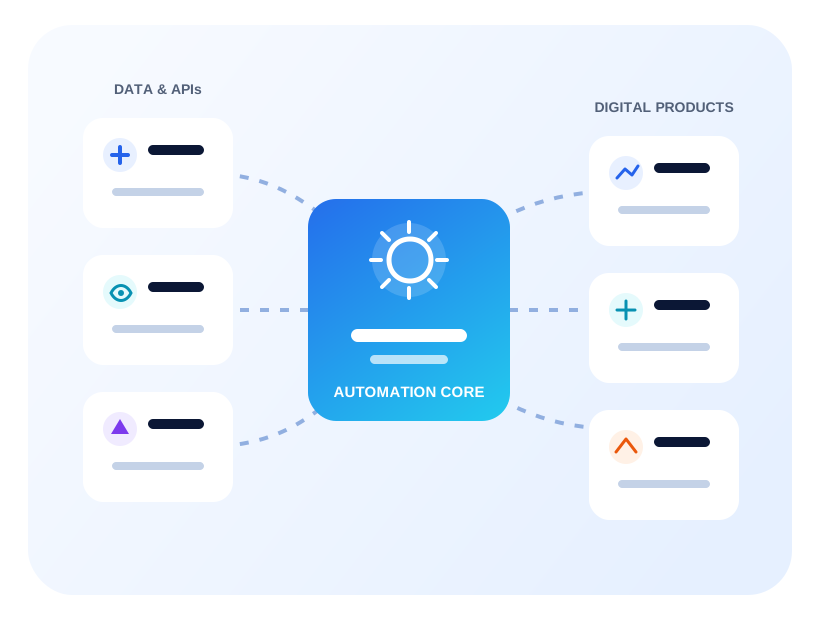 Original Urban Sky Web illustration
That was the original problem. Urban Sky Web is building the infrastructure intended to make that limitation increasingly irrelevant.